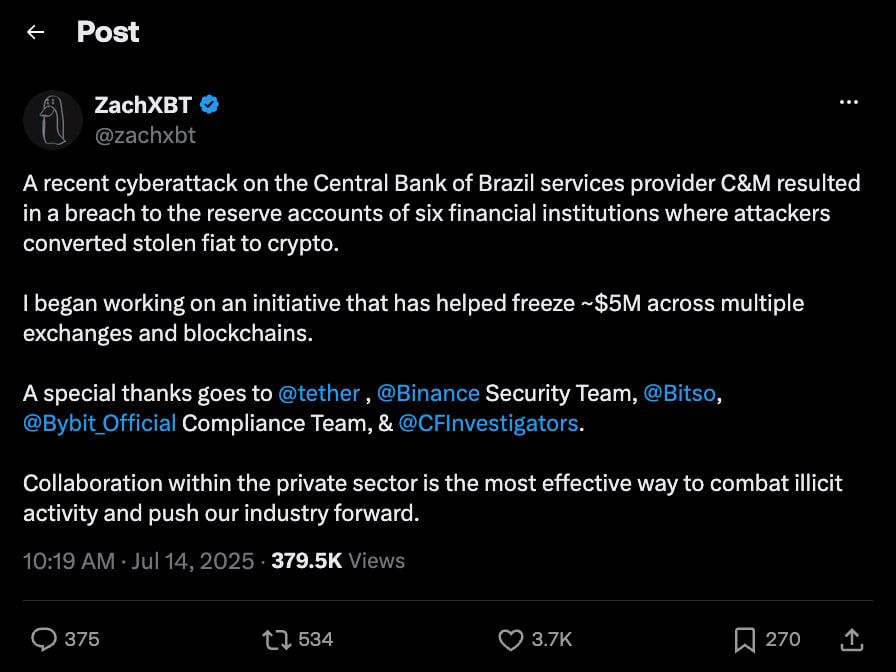
After attackers breached a service provider connected to the Central Bank of Brazil and moved proceeds into crypto, rapid tracing led to $5M frozen.
Attackers compromised a technology service provider connected to the Central Bank of Brazil and used that access to move stolen funds into cryptocurrency, a laundering strategy chosen for speed, which cuts both ways. What makes crypto attractive for cash-out also makes it traceable in real time.
As the proceeds hit exchanges and OTC channels, tracing work identified the deposit points fast enough for services to act. Five million dollars of the converted funds were frozen before they could be dispersed.
The case is a study in response time: once stolen fiat becomes onchain value, there is a short window where public tracing and cooperative exchanges can immobilize funds. Here, that window was used.
July 2025
A service provider connected to the Central Bank of Brazil is breached; stolen funds are converted into cryptocurrency for laundering.
July 14, 2025
Real-time tracing identifies exchange deposit points; $5M is frozen at cooperating services and the findings are published.